

Day 2 kicked off with a welcome from Bob Kelly, who is the Chairman of the Sales Management Association. He shared that usually there are about 1/3 of attendees are returning, and this year the conference is focusing on the following themes:
- Change
- When he asked the audience what types of change their organizations were undergoing, attendees responded with change associated with CRM changes, mergers and leadership team reorgs).
- The research that he shared reported that 80% of sales organizations are going through some level of change, usually a high degree, which can be disruptive and a troubling issue because few organizations implement change very well.
- The change usually also doubles down on the disruption because there aren’t capable change agents and managers.
- Technology
- Technology is usually responsible for most of the disruption, including how organizations interact with their customers. Few people are getting CRM right (only 24% who use a CRM outperform their peers) – it can be a bell-weather with a lot of investment, and some opinions are that CRM is destroying more value than creating.
- The value of technology is usually overstated unless it’s harnessed in the right ways.
- Learning
- Early on in the industry, we didn’t call out titles like Sales Enablement, Sales Ops, Sales Effectiveness. Those aspects fell to leadership and management to train and scale their sales organizations.
- The change has been needed because we need to continuously retool and grow sales team capabilities, which can only be done with training. Technology can then be leveraged to make the training more effective.
- Values and Culture
- The final theme was highlighting that the importance of values and culture of the sales organization can be undervalued and a place where organizations don’t often look for impact.
- How we motivate and encourage salespeople relies on culture, and we need techniques on how to build a strong culture.
Bob then closed by mentioning that some of his MBA students from Emory were attending and invited us to his class this evening, which he’s hosting in the conference ballroom.


Keynote – The Shocking Truth About Process Driven Sales Methodology
Scott Weinhold, Executive Director at Vantage Point Performance, held a high-energy session focused on uncovering why abandoning process-driven sales methodologies for more “agile” approaches see higher win rates.
(Okay, maybe this content is resonating with me way more than I was expecting it to!)
Scott opened with a great build-up of all the “great” methodologies that are out there. There’s so much noise – how do sales leaders and organizations know where to prioritize focus, team and talent to maximize return? How do we lift revenue, improve win rates and get more reps hitting quotas?


Or, is it possible that all this noise is contributing to the negative results that we’re seeing in the industry where only about 52% are hitting quotas?
Scott then walked us through a study that was done at the Florida State University Sales Institute on the best sales methodology. Starting with the Challenger Sale back in 2012.


Below is the approach that was taken for the four studies – first with a Seller Type Study, then a Situational Study, a Situational Win Rate Study and finally an Agile Diagnostic.


Study 1 – Seller Type Study


The Top 25% self-reported that they used either a Challenge or a Consultative approach; the Top 50% identified most with Consultative. Those who identified highest with a Relational approach were in the Bottom 25%.
Study 2 – Situational Study
Because the first study focused on how sellers are identifying themselves, the next study moved to a more situational one. Asking the question – for various situations, what approach did you take? The question was asked to 1,500 reps across there different companies.


What the study found was that the top sellers (those in green) adapted their approach based on the situation. The approach depended on the kind of customer, how the customer made decisions, the team around the customer and any competition, etc – all the variables that go into winning the business.
Top performers had a lot more variance in the approach. The situation drove top performer selling strategies and Disruptive was the dominant strategy for only 30% of situations.
Study 3 – Highest Win Rates


The third study asked reps to share the situations that they face; what buying scenarios were encountered. And for each one, what did you do? How did those activities/approaches compare to win rates?
This helps identify strategies of high performers in the organization. What was found for high performers was that they adapted their approach based on the situation. Lower performers took the same approach and used the same method in every scenario – a more rigid approach.
This is where agility comes in – the higher performers were able to adapt. The study found that high performers had high situation awareness and could adapt as needed in the moment – they were experts in recognizing dynamics.
So how can that be shared with the rest of the organization? Build out the tool kit, help others improve by matching and mapping approaches to various buying situations for the rep to be able to successfully execute.
In the study, for organizations that had heavily scripted sales processes, the highest performers did not usually stick to the script. (Side note: this reminded me of a talk that Doc Norton held many years ago about learning competency models and how when he was selling magazines over the phone, there was a script to follow, but once he built up the knowledge, he stopped following the script and he was able to close more sales.)
Scott compared this to a NFL Quarterback needed to adjust the play once the situation was assessed.


The research concludes that no sales strategy is a clear winner; that the winning sales strategy was dependent on the selling situation and that on average, sellers faced 4 to 5 unique situations, of which, the top performers used, on average 4 to 5 patterns of selling behaviors.
Next came the research about how the customer buying experience is broken – 68% of buyers said that “sellers don’t understand” and 61% said that “sellers don’t adjust.” The lack of situational fluency contributes to this dysfunction – reps aren’t connecting with what’s important and recognizing that one size does not fit all.
In the 2×2 grid below, the percentage in Green is the percentage of time of a one hour meeting that the Customer thought was in that quadrant. What’s in Red is what the Seller said.


Customers are reporting that 50% of the content is not important to them and 75% is what everyone else is saying. On 10% resonated because it was important and unique.
So what do we do? If on average 20% of an organization are high performers, what about the other 80%? The suggestion is to train on agility so that reps can be prepared to adapt as they learn more situational awareness.
How do you train on agility? The FSU study researched various organizations that were required to be agile, e.g. the military, sports programs and trauma centers.


Then Scott shared the insights that are needed to be analyzed to better understand the tactics.


He wrapped with the final “back of the napkin” plan that was built throughout the presentation. That it’s:
- Standardization -> Situations
- Rigid Methodology -> Agility
- Dogmas and Platitudes -> Data and Evidence


Keynote – Implementing World Class Sales Leadership Development at Johnson Controls
In this session, Adrian Voorkamp, Director, Learning Deployment – Americas at Jonson Controls shared how Jonson Controls implemented an award-winning comprehensive program to build great first-line sales managers.
The CEO of Jonson Controls issued a goal of having 10% compounding annual growth (CAGR), and the sales leadership quickly realized that if everyone achieved their individual goals, the company still wouldn’t meet that overall goal – so they needed to hire in more sellers and more Sales Managers. They were confident in their seller training, but needed to have better Sales Leadership Training.
Adrian opened by explaining that the Sales Manager role is very different than other managers in an organization, and that’s usually where generic L&D training fails. It’s not one-size-fits-all.


Sales leaders are hired/fired by the numbers that their team brings in; however, between those numbers and the leader lie dozens of variables. It’s very fly-by-the-wire where controls are not directly linked, for example, there is reliance on the customer to have to sell the product internally to other team members at the company.


Sales Managers were also too focused on the data and didn’t dig into the “why” – they were experts on the tools, but not on the trade. They spent time on forecasting, pipelining, upside scenarios, etc.


In Sales Leadership, authority doesn’t always equal influence, and assuming that folks are appropriately influenced will cause time to be focused on the wrong things, e.g. working hard (more hours) does not always equal results.

Managing is not a factory, assembly line process – the critical success factors for their Building Sales Leaders program included:
- Multi-Modal Learning – very specific modules in varying formats
- Continuous Learning Calendar – not a “one and done”
- Executive Sponsorship and High Visibility – importance needs to be stressed at all levels
- Application Accountability – Sales Managers’ bosses would observe them in a role-playing session with their sellers.
- Dedicated Program Management


Other takeaways:
- They did not leverage too much event-based curriculum (butts in seats)
- They leveraged their Business Partners to help with shepherding learning cohorts through the program.
- The two most important factors were Application Accountability and Dedicated Program Management (promise I didn’t pay him to say this 🙂 )
- The sessions are about a week-long
- The Collaboration Portal is built in Sharepoint
- He suggested looking into WalkMe which is an add-on to Salesforce.com that can help provide step-by-step guidance (I’ll ask Chelsie to check it out).
- His perspective is that an LMS is where learning goes to die – learning needs to be contextual, not just follow-up that training was completed.
- The level of integrity within the team can be traced to the Sales Manager.
- They train their Sales Managers on the Seller Rep training (before the Sellers, when possible) so that the Sales Managers have an understanding and can help coach and ensure application accountability. That there isn’t a disconnect between training and Sales Manager expectations.
- They partnered with Gartner to do a 90 question survey to their sales force asking them questions about their managers.
As far as results – one year later, Learners outperform peers by 8 points in quota/budget attainment.


Improving Sales Execution
In this session, Michelle Vazzana, Ph.D., Chief Strategy Officer at Vantage Point Performance, answered the questions why do many sales organizations have such trouble with sales execution? She shared the common disconnects between a sales organization’s expected outcomes and their sales force’s ability to execute.


The session is based on a study that she and her team conducted, so she covered the research approach, the key findings and the implications for coaching. More information can also be found in her book Crushing Quota.
Some of the key points from the intro were:
- The number of Sales Manager roles has almost doubled year over year (92%).
- There is an assumption that Sales Managers know all the tools and techniques.
- On average, 52% of sellers hit quota, which has been steadily decreasing for the last six years.
- When looking at tenured Sales Managers and new Sales Managers, there wasn’t a high variance in quota attainment, only about 9%.
The first study looked at what type of coaching mattered most when it comes to salesperson performance – and coaching was categorized into Capabilities, Activities and Outcomes.


- Capability coaching was around questioning, objection handling, assessment and probing for problems.
- Outcome coaching was around reducing sales cycle length and having a strong pipeline.
- Activity coaching was around the seller’s actions and behaviors.
Coaching on actions and behaviors impacted performance at a 24% higher rate than the other coaching areas. Activity coaching was also found to have the least amount of training investment and was the least formalized.


The second study focused on the details of the coaching practices.


The study found that Sales Managers are the key:


She stressed the importance of reviewing the data to ensure that Sales Managers aren’t hitting their quotas on the “backs of their high performers;” that a large proportion of their sellers need to attain quota.
She also stressed that salespeople are not “coin-operated” and asked the group of the following, which has the biggest impact on seller motivation: A) Incentive Compensation, B) Achievement Drive or C) Task Clarity.
It’s C.


First she explained what she meant by Sales Coaching.


In the session, we covered Opportunity Coaching and Call Coaching, and she described what the Critical Mass did vs. the High Performing Few.
The Critical Mass:
- Attends sales calls most frequently
- Spend more time than their organization requires
The High Performing Few:
- Attend sales calls less frequently
- Spend about the time required (or slightly less)
The High Performing Few recognize when a deal is important and will be in the field; they’re better at qualifying the deals and understanding the complexity of the deal
When it comes to Coaching Sessions:
The Critical Mass:
- Spends over 10 hours per month
- Frequently (several times per week, weekly)
- Short Duration (under 30 minutes)
- Plan when the seller requests their help
The High Performing Few:
- Coach ~5 hours per month
- Less frequently (bi-weekly, monthly)
- Spend more time (1 hour)
A higher number of coaching sessions do not equate to higher performance. The High Performing few are able to go deeper into the conversations, and don’t sepd time scrubbing pipeline and/or forecasting.
Other differences of The High Performing Few are:
- that they are discriminating and effective at prioritizing; they realize they can’t coach everyone every week on everything.
- that they determine the minimum amount of rigor needed in a situation and the minimum amount of discipline needed to drive successful behaviors.
- that they recognize that processes are usually over-engineered and only work in the optimal structure and situation.
- possibly not previous top sellers, which may not always lead to someone being a top coach.
- having longer, deeper coaching conversations and discussing fewer topics.
- they have structured agendas and that structured conversation matters; just enough structure/just enough discipline.
- able to orientate approach early in the sales process and determine what activities matter.


Other suggestions that came up in the Q&A:
- Regarding quota setting, she responded that sales is an imprecise science – quotas will never be 100% perfect and there are still subjective measures. The goal is to be “as close to possible to roughly right.”
- Because activities drive outcomes, formalize coaching to the Sales Manager role.
- The more complex the sales cycle and the further up the “food chain,” the less frequent coaching needs to happen.
- When asked how to determine activities that drive outcomes, she responded that one should go to their high performers and interview to learn what is the minimum level of rigor around details to drive intended behaviors.
- Ensure that technology is taking on the manual work.
- Have clear expectations of Seller performance before coaching conversations (she shared a story where a manager’s 1:1 was where the seller gave a verbal update the manager updated Salesforce).
- Leverage company-wide models for general performance reviews, but it will likely have too much variability for Sales, so there will need to be something in addition for the Sales organization – to her knowledge no organization has “cracked this.”
Case Study – Sales Performance Management Solutions – Technology OVerview and Cox Automotive Case Study
In this session, Scott Werstlein (VP, NA Sales for OpenSymmetry) and Phillip Etefia (Senior Manager – Sales Incentives) shared their work together on Sales Performance Management systems and shared how Cox Automotive implemented one in their Sales Organization.

Sales Performance Mangement (SPM) is defined as the system by which seller performance is analyzed, planned, implemented and managed.


SPM systems automate, create actionable insights and enable seller performance, for example, when it comes to the time to payout commissions to sellers, payouts are faster than with Excel or Homegrown solutions. There are also fewer errors.


Forrester Research also shows better enablement:

After that intro on what SPMs are, Phillip shared what was implemented at Cox Automotive where inconsistent performance management was equally $63M in wasted revenue.


Some of the problems they were looking to solve for were:
- Salespeople not trusting payouts; wasting time validating numbers.
- Drive down the “shadow” accounting functions
- How to create more trust and transparency
- How to reduce the “noise in the system” from the lower end of the spectrum
- Create more accountability
- Be able to review seller performance data to look for trends – have sellers had performance problems before? Exceptions were classified.
- Reduce the risk and subjectivity of the performance management process
Other insights:
- For rankings, they use quota attainment, reach and consults (with an audit to ensure that there is some level of truth)
- They leveraged the sales segments in SPM because challenges and ranking variables will be different
- They publish rankings monthly so that sellers can see where they’re ranked amongst their peers.
Wow – that was all before lunch!!!
Keynote – The Changing Role of First Line Sales Managers
This was a fun panel format hosted by Bob Kelly and featured Jason Jordan (Management Consultant) and Noel Capon (R.C. Kopf Professor of International Marketing at Columbia Business School).
Dr. Capon kicked off the session with the results of research that he and his team did on the Front Line Sales Manager and the competencies needed because the role is distinct from Sales Managers. He kicked off the study because when he asked his students to find any written literature on the topic, there wasn’t any to be found.


The study centered on three questions:
- How important is the FLSM role?
- What are the key competencies for an effective FLSM?
- What should sales leaders do?
He shared the research study design:


Before getting into what makes an effective FLSM, he explained that it all comes down to various types of acumen.


- Strategic Acumen – know where the company is going, where customers are going and the ability to strategically use resources.
- Organization Acumen – know where decisions are being made in a customer’s org; who are the influencers, who owns the budget, who makes decisions, and bringing people in as needed.
- Business Acumen – Need to be able to make deals, not used to the product doing the work of the sale, can do the business math.
- Team Building Acumen – harness the skills and competencies into something more – for example, ensuring that customer service teams are effectively set up to serve the customer so that they can get out and make more sales.
- Resource Acumen – where to find help in the organization and obtain that help without the line of authority.
- Personal Acumen – integrity and management style/not a micromanager


He closed by admitting that there “probably isn’t anything too special about this;” however, he asked the audience if we were hiring with these dimensions or are we hiring strong salespeople?
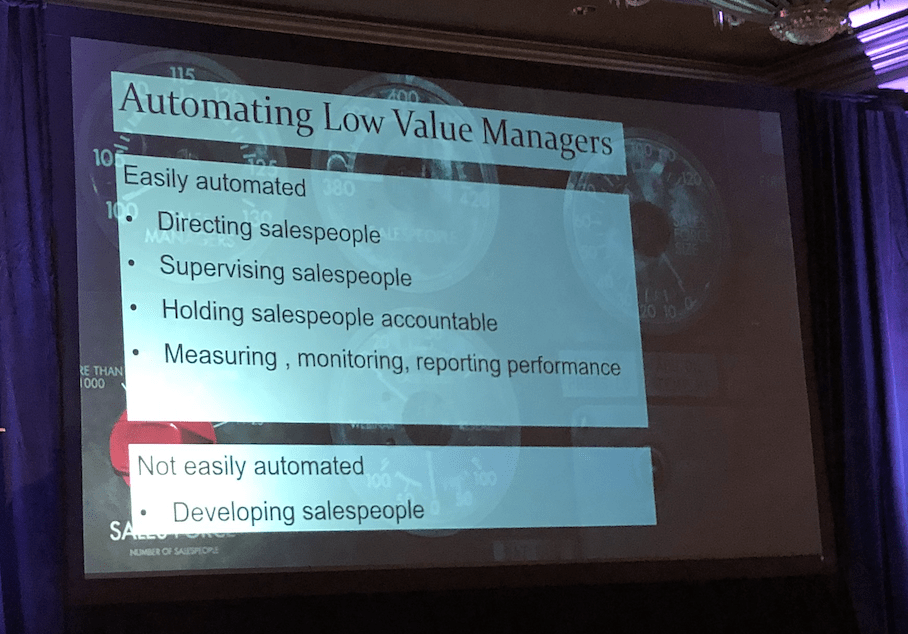
Jason Jordan then took to the podium to talk about what’s changed in sales management, and it’s not just the tech. The tech is more accessible, but it’s also more fragmented.
He shared that just like the evolution of no longer doing “big bang” tech deployments, we need to let go of the assumption that all great salespeople naturally will make great managers and teach managers how to manage.
He shared the various selling roles through the lifecycle and how new roles have been introduced over the last decade by showing the Google graph of searches of the various roles:


Bob Kelly then talked about the technology and the investment in CRMs – including the benefits that are being gained by those who are doing it right.




Then there was a Q&A session from the audience, and some notable questions were:
- Is it more important for an FSLM to be a Player/Coach or just a Coach?
- It’s more important for them to be a Coach. However, there are times where they will need to be a player, for example, in some customer relationships.
- Regarding a question of quota setting:
- The quota setting process has changed a lot in 15 years – where there was a lot of back and forth, then top-down, then bottom-up. Now the number is more coming from the top down.
- Other Notables:
- One metric to look at is the number of Sellers lost to promotion.
- Keep in mind that specialization puts more burden on the sales manager.
- Technology can help a geographically dispersed team.
- Growth focused orgs – promote from within, build a bench of managers, and retain the best sales managers.
Panel – Understanding and Managing Sales Force Culture
This was a panel, also lead by Bob Kelly, with the following panelists:
- Loren Waldo – Senior Manager, Sales Support – Gulfstream Aerospace Corporation
- Matthew Pritchard – Co-Site Lead, Google Atlanta and Head of Industry, Retail
- Tina Reese – Executive Director, Sales and Relationship Management – JP Morgan Chase

Lots of great tidbits coming out of this session, although most of the discussion was focused on general culture topics, not necessarily sales org cultures.
- Effective sales orgs are moving from a culture of embracing stability and control to one where flexibility and creativity is valued.
- There’s a culture of learning; we all have our own ways on how to do something; need to avoid a culture micromanagement and just “telling people what to do.”
- In a sales culture, typically, individual success is valued, the collective whole isn’t emphasized and the potential to have more “carnivores and barbarians” makes culture dicier.
- When discussing incentive structures, it was suggested to do both individual performance and whole team success. One example is an individual incentive, team quarterly bonus and equity in the company so that all levels are included.
- Culture in an organization could be compared to religion and denominations where the religion is the company’s holistic culture, and then there are sub-cultures for different departments (Sales, Ops, Finance, etc).
- Sales is a more performance orientated culture.
- Be mindful that the Sales org could have a perception of receiving special treatment. Ensure that rockstars are seen as equals – have humility and are more visible.
After the culture session, I went back to the other ballroom, and caught the final minutes of the previous session in that room, and grabbed the below snippets:
- The language of the leader is what sets the culture
- Training is not just about the deals, but about the person, so we need to train the whole person.
- Need to reinforce and in a time-phased way. Gave the example of learning how to play tennis – you could go to a day class with Serena Williams and then have an app to learn with, but without the coaching and accountability and real play (vs. role play), the training won’t be effective.
Sales Enablement Case Studies – Learn How Sales Organizations are Rethinking Sales Learning and Development
Last session of the day! In this session, Larkin Madden (Sr. Manager, Customer Success at MindTickle) and Mike O’Dea (Manager, Sales Enablement at Automation Anywhere)
Larkin opened with a summary of the state of the state:


Some highlights:
- 6.4 is the average number of decision-makers on a typical B2B purchase.
- Buyers are more informed, with only 23% looking to salespeople as the preferred resources for information and problem-solving.


Trends that MindTickle is seeing:
- Flipped Classroom – testing in and out of boot camp scenarios
- Push vs. Pull – moving to pull, which is tough in a classroom training; however, it provides for more cross-functional learning.
- Manager -> Rep driven coaching – we should be responsible for our own learning
- Manager Enablement – geared towards managers as a persona. How do you coach this topic? Get ahead of these things and get skin in the game because they’ve already gone through the training.
- Top-Down -> Peer to Peer – Coaches to mentors, creating a bench, leading without formal authority, group of certifiers for each part of the sales process.
- Sales Quota -> Learning Quota
- Cross-Functional Program Team – get buy-in and feedback early
- Completion -> Competency/Capability – capability index, not just completion; care about hitting quota


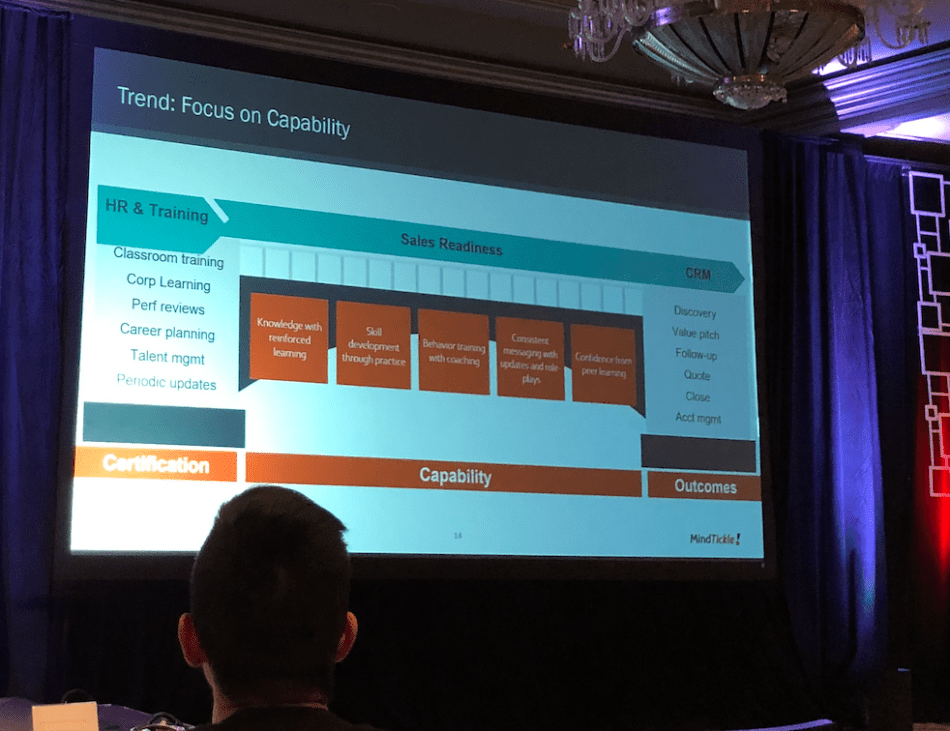


Then we got into various case studies related to onboarding new sellers:


Mike then shared the work that LinkedIn did with MindTickle:


And then how MindTickle was used to solve problems at Automation Anywhere (who hires 1,000 sales reps/year):


Other takeaways:
- What matters is content at the moment it’s needed.
- Be mindful of strategies to counteract the Forgetting Curve. Build neurons to recall info by having time spaced learning and learning adjusts based on whether or not you got the answer right or wrong (MindTickle uses science out of Harvard).
- Success can be found with a weekly Sales email or a 2-minute video produced internally
- Be mindful of tribal knowledge and how to share that out with the rest of the organization.
- Have assessments of competencies to rate the level of mastery, including where the learn thinks they are and dive into areas to learn more.
- Technology can also help ensure that Partner Sellers are also kept up to speed; at Automation Anywhere, they have licenses that allow partner sellers to also access the platform.
- Four-Door Learning Methodology – the Playground, the Cafe, the Evaluation Center and the Library – which supports varied learning styles.
Wow, what a day! After this session, the cocktail hour started, and I had the chance to catch up with a few people who had participated in the sessions and I found the networking valuable.
Looking forward to tomorrow!